
Exploring the Projects Shaping Central Alabama’s Future
Birmingham has served as the region’s economic engine and cultural hub, attracting major concerts, conventions, sporting events, nationally recognized restaurants, and nightlife experiences that draw visitors from across Alabama and beyond. It remains the destination many people choose for world-class entertainment and large-scale events.
At the same time, communities surrounding Birmingham are creating destinations of their own.
Whether it’s shopping in Irondale, outdoor recreation in Gadsden, youth sports in Oxford, lake living in Pell City, new industrial opportunities in Springville, or family attractions in Blount County, cities throughout the region are investing in projects that create reasons for people to travel across county lines.
That’s good news for everyone.
Today’s economy isn’t confined by municipal boundaries. Families routinely travel throughout Central Alabama for work, recreation, shopping, dining, healthcare, and entertainment. When one community lands a major project, neighboring communities often benefit as well.
As the Pell City Podcast prepares to launch Season 2, one of our goals is to broaden the conversation. We want to explore the projects shaping not only St. Clair County, but the surrounding counties that influence where we live, work, shop, and spend our time. From Jefferson County to Etowah County and beyond, exciting developments are creating new opportunities throughout Central Alabama.
St. Clair County: Building Regional Momentum
We’ll begin at home.
St. Clair County continues to benefit from its strategic location along the Interstate 20 and Interstate 59 corridors. Logan Martin Lake remains one of Alabama’s premier recreational destinations, attracting thousands of visitors each year while supporting restaurants, marinas, lodging, retail, and countless small businesses.
Springville continues positioning itself for long-term industrial growth through the new Springville Commerce Park, a rail-served industrial development designed to attract manufacturers, logistics companies, and high-quality jobs for the region.
In Ashville, something as simple as the opening of QuikTrip has already begun changing travel patterns. More drivers are exiting Interstate 59 for fuel, food, and convenience items, creating additional exposure for local businesses and increasing traffic through the community. It serves as a reminder that economic development isn’t always measured by billion-dollar announcements. Sometimes it’s about creating new reasons for travelers to stop, spend money, and discover a community they may have otherwise passed by.
Pell City itself continues expanding its commercial footprint with projects that strengthen the city’s role as a regional destination. The addition of Olive Garden and LongHorn Steakhouse have provided even more nationally recognized dining options that many St. Clair County residents previously traveled outside the county to enjoy. These restaurants join an expanding retail corridor that includes Hobby Lobby, TJ Maxx, Old Navy, Ross Dress for Less, PetSmart, Ulta Beauty, and numerous other national retailers, reinforcing Pell City’s position as one of eastern Alabama’s fastest-growing shopping destinations. What’s exciting is how the small business owners can also share in the economic opportunities as people exit I-20 in search of unique food options and shopping experiences.
The hospitality industry continues to grow as well. The new TownePlace Suites by Marriott, the first Marriott-branded hotel in St. Clair County, provides additional lodging for visitors traveling to Logan Martin Lake, youth sporting events, business meetings, and regional tourism attractions. Combined with continued residential development and infrastructure improvements, Pell City is steadily strengthening its position as one of the region’s fastest-growing communities.
Jefferson County: A Regional Economic Engine
Jefferson County continues to serve as the economic engine of Central Alabama, with communities throughout the county making investments that extend far beyond their own borders.
One of the biggest stories is undoubtedly the arrival of Costco in Irondale. The significance of this project extends well beyond Jefferson County. Families from Pell City, Moody, Leeds, Oxford, Gadsden, Trussville, and numerous other communities are expected to make regular trips to Costco. Those same visitors may also stop for lunch, fuel their vehicles, shop at neighboring businesses, or spend time enjoying attractions such as K1 Speed, Barber Motorsports Park, or the Irondale Auto Mall. That’s exactly what economic developers hope for—one destination creating opportunities for dozens of surrounding businesses.
Irondale is also investing in a new civic center, exploring the possibility of creating a municipal school system, and continuing to recruit new businesses while strengthening existing employers. Together, these initiatives demonstrate how a city can position itself for long-term growth rather than relying on a single announcement.
Just a few miles away, Birmingham continues reinforcing its role as the region’s cultural and entertainment center. The new Coca-Cola Amphitheater, continued investment around the BJCC, and redevelopment projects like The Star at Uptown are attracting concerts, conventions, sporting events, residents, and private investment that benefit businesses throughout Central Alabama. According to the BJCC, its venues generated more than $463 million in economic impact across the seven-county region in 2025, underscoring the importance of regional entertainment as an economic driver.
Elsewhere in Jefferson County, projects such as the $150 million Alabama Farm Center in Warrior and ongoing industrial recruitment in McCalla continue expanding the county’s economic footprint, creating new jobs while providing additional destinations that attract visitors from surrounding communities.
Viewed together, these projects illustrate an important point: Jefferson County’s economic success doesn’t belong to one city. It creates opportunities that ripple across the entire region.
Etowah County: Diversifying the Economy Through Industry, Recreation, and Quality of Life
Etowah County continues proving that successful economic development isn’t built on a single industry. Instead, community leaders throughout the county are creating a diverse economy that combines manufacturing, retail, tourism, outdoor recreation, and quality-of-life investments.
The biggest headline may be the announcement that global automotive supplier Minth Group will invest $430 million to transform the former Republic Steel property in Gadsden into its largest North American manufacturing campus, creating more than 1,300 new jobs. The project represents one of the most significant economic development announcements in Northeast Alabama in recent years and has the potential to strengthen the region’s automotive manufacturing sector for decades to come.
At the same time, Gadsden continues revitalizing its commercial corridors through new retail investment. Projects including Rural King, 7 Brew Coffee, Zaxby’s, and the upcoming Burlington store are bringing new jobs while breathing life back into existing shopping centers. Rural King alone is investing approximately $12 million to redevelop the former Midtown Gregerson’s shopping center and is expected to employ around 90 full-time workers, while creating additional opportunities for surrounding businesses to expand.
But perhaps one of Gadsden’s greatest strengths is its continued investment in quality of life.
Communities across Alabama are learning that attracting new residents often requires more than jobs alone. People want places where they can hike, kayak, fish, enjoy festivals, explore downtown districts, and spend time outdoors.
Gadsden has embraced that philosophy.
Investments in Noccalula Falls Park, Coosa Landing, the Black Creek Trails, Lake Neely Henry, and the city’s vibrant downtown continue strengthening Gadsden’s reputation as one of Alabama’s premier outdoor recreation destinations. Downtown events such as First Friday, expanded dining options, arts programming, and local festivals are creating reasons for residents and visitors alike to spend more time—and more money—in the community.
Infrastructure improvements are also helping prepare the city for future growth. Projects such as the East Gadsden Connector (I-759 extension), drainage improvements around the former Agricola Shopping Center, and new public safety facilities demonstrate a long-term commitment to supporting both residents and future business investment.
Economic development extends beyond Gadsden’s city limits as well.
Communities throughout Etowah County—including Attalla, Rainbow City, Southside, and Hokes Bluff—continue attracting residential development, expanding retail opportunities, and supporting the county’s growing manufacturing base. Together, these communities help create a regional economy that serves residents from Cherokee, DeKalb, Marshall, Blount, St. Clair, and Calhoun counties.
Etowah County appears to be following a balanced strategy: attracting major employers, revitalizing commercial districts, investing in recreation, and improving quality of life. That combination not only creates jobs—it creates destinations.
Calhoun County: Sports Tourism and Shopping Continue to Grow
Calhoun County continues expanding its reputation as one of East Alabama’s most diverse regional economies.
Oxford has spent years building one of Alabama’s strongest shopping and sports tourism destinations. The combination of Bass Pro Shops, Oxford Exchange, Choccolocco Park, and continued industrial investment attracts thousands of visitors each year for shopping, youth sports tournaments, and business.
At nearby Fort McClellan in Anniston, another project has the potential to reshape an entirely different industry.
Comedian, actor, and entrepreneur Katt Williams is developing Kemet Movie Works, a production campus envisioned as more than a traditional movie studio. The project aims to combine film and television production with workforce development, education, and emerging technologies such as artificial intelligence, augmented reality, CGI, and virtual production. Through a partnership with HBCU Miles College (Jefferson County), the initiative also includes scholarships, internships, and training opportunities designed to prepare Alabama students for careers in the rapidly evolving entertainment industry.
If successful, the project could position Calhoun County as a destination for film production, digital media, and creative technology while generating new opportunities for tourism, hospitality, and small business throughout East Alabama. Like sports tourism in Oxford, the entertainment industry has the potential to create a ripple effect that extends well beyond county lines, benefiting restaurants, hotels, retail businesses, and service providers across the region.
Blount County: Building a Regional Destination Through Recreation, Retail, and Quality of Life
Blount County is taking a unique approach to economic development by balancing industrial recruitment with investments in recreation, retail, tourism, and community development.
At the center of that strategy is Oneonta, which continues strengthening its role as Blount County’s commercial hub. The city recently celebrated the groundbreaking of a new 50,000-square-foot Food City, a major grocery investment expected to serve residents throughout Blount County while attracting additional retail activity to the area. The state-of-the-art supermarket represents another sign of confidence in Oneonta’s continued growth as the county’s primary shopping destination.
One of the county’s most exciting long-term projects remains HomeTown Sports, a planned regional sports complex that has the potential to transform Blount County into a destination for youth basketball, volleyball, pickleball, soccer, and other tournaments. Designed with indoor courts, multipurpose fields, RV accommodations, meeting space, and event amenities, the complex is expected to attract teams and families from across North Alabama while generating new business for hotels, restaurants, retailers, and local attractions.
Blount County is also investing in long-term economic growth by expanding opportunities within the Oneonta Industrial Park, where shovel-ready sites and infrastructure improvements are positioning the community to attract future manufacturers and employers. City leaders continue promoting Oneonta’s central location between Birmingham and Huntsville, quality schools, healthcare services, and workforce training partnerships as competitive advantages for new business investment.
Beyond business recruitment, Blount County continues capitalizing on its natural beauty through expanded promotion of hiking, kayaking, cycling, parks, and outdoor recreation. Combined with community events, downtown revitalization, and tourism initiatives, these investments demonstrate that quality of life has become an important part of the county’s economic development strategy.
Blount County appears to be following a balanced approach to growth—one that recognizes successful communities are built not only through job creation, but also by creating places where families want to live, visit, and spend their time.
Talladega County: Manufacturing, Motorsports, and Higher Education
Talladega County continues to build one of Alabama’s most diverse economies by combining advanced manufacturing, motorsports tourism, higher education, and industrial expansion.
The county remains home to Honda Alabama Manufacturing in Lincoln, one of the state’s largest automotive production facilities and a major employer for residents throughout Talladega, St. Clair, Calhoun, Jefferson, and Shelby counties. Honda’s continued investment in new vehicle production reinforces the county’s position as a cornerstone of Alabama’s automotive industry.
The county is also seeing continued industrial growth. In Childersburg, companies including Cooper Steel South and Automation Robotics and Controls are expanding operations within the industrial park, creating additional manufacturing jobs while strengthening Talladega County’s industrial base. At the same time, the newly launched East Alabama Rural Innovation Training Hub (EARTH) is working with communities across the region to develop workforce solutions and support rural economic development.
Tourism continues to be one of Talladega County’s greatest economic drivers.
Each year, Talladega Superspeedway welcomes hundreds of thousands of race fans from across the country, generating millions of dollars in economic activity for hotels, restaurants, retailers, campgrounds, and local businesses throughout East Alabama. Combined with attractions such as the International Motorsports Hall of Fame, Cheaha State Park, and the county’s growing outdoor recreation opportunities, Talladega County continues attracting visitors well beyond race weekends.
Education also plays an important role in the county’s future. Talladega College, Alabama’s oldest private historically Black liberal arts college, continues serving as an educational, cultural, and economic asset. Students, faculty, athletic events, commencement ceremonies, and community programming bring thousands of visitors into the city each year while contributing to the local economy.
Taken together, manufacturing, tourism, education, and workforce development continue positioning Talladega County as one of East Alabama’s most balanced regional economies.
Shelby County: Growth Through Business, Housing, and Corporate Investment
Shelby County has long been one of Alabama’s fastest-growing counties, and that momentum continues today through a combination of corporate investment, residential development, transportation improvements, and retail expansion.
Communities including Hoover, Pelham, Alabaster, Helena, Chelsea, Calera, and Columbiana continue attracting new residents and businesses, while the U.S. Highway 280 and Interstate 65 corridors remain two of the state’s most active areas for commercial and corporate growth. Shelby County’s diverse economy includes major employers in healthcare, manufacturing, education, finance, distribution, and professional services, making it one of Alabama’s strongest business environments.
Infrastructure improvements continue supporting that growth. The planned widening of Interstate 65 between Alabaster and Calera, along with other transportation improvements throughout the county, is expected to improve traffic flow, strengthen freight movement, and support continued residential and commercial development along one of Alabama’s busiest interstate corridors.
Shelby County also benefits from a thriving tourism and recreation economy. Oak Mountain State Park, the Oak Mountain Amphitheatre, and numerous youth sports complexes attract visitors from throughout the Southeast. Those visitors support hotels, restaurants, retail centers, and entertainment venues while generating additional economic activity for communities across the county.
Residential development continues at a remarkable pace, particularly in communities such as Chelsea, Helena, and Calera, where new neighborhoods, schools, and commercial developments are reshaping the landscape. As more families choose Shelby County as home, demand for retail, healthcare, dining, and professional services continues to grow, creating opportunities for businesses throughout the region.
Shelby County demonstrates how sustained investment in infrastructure, quality schools, parks, housing, and business recruitment can create long-term economic success. More importantly, its continued growth benefits neighboring counties as residents travel throughout Central Alabama for work, shopping, recreation, and entertainment, reinforcing the idea that today’s economy extends well beyond county boundaries.
The Central Alabama Growth Corridor
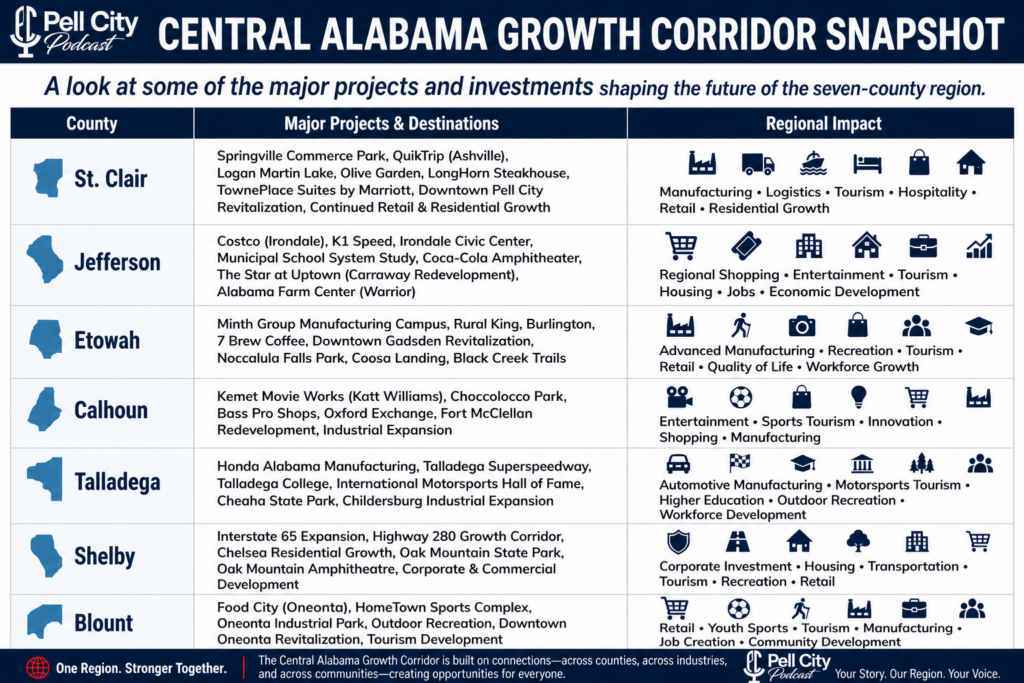
Together, these seven counties represent one of Alabama’s most connected regional economies—a place where people routinely cross county lines for work, education, healthcare, recreation, shopping, and entertainment. As new projects continue to come online, those connections are only expected to grow stronger.
For Season 2 you can expect great conversations with community leaders, elected officials, business owners, economic developers, entrepreneurs, educators, and residents to discuss the projects shaping our future—not just within one city or county, but across the entire region.